Elementary occupations · code 9331
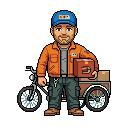
Hand and pedal vehicle drivers
An app can assign the delivery. Getting through traffic on a bike is still legs and nerve.
Collecting fares is mostly out of AI's reach. Loading goods, helping passengers and looking after the vehicle it barely touches.
What they actually do (and what else they get called)
Hand and pedal vehicle drivers propel cycles, hand carts and similar vehicles to deliver messages and transport passengers or goods. Tasks include - (a) loading and unloading goods, or assisting passengers in getting on or off a vehicle; (b) moving vehicle in the desired direction with due regard to other traffic and traffic regulations; (c) inspecting vehicle components to identify wear and damage; (d) maintaining vehicle, making minor repairs and installing replacement parts; (e) collecting fares or charges. Examples of the occupations classified here: - Bicycle courier - Cycle rickshaw driver - Pedal vehicle driver - Rickshaw puller Some related occupations classified elsewhere: - Bicycle racer - 3421 - Motorcyclist - 8321
- bicycle courier
Job titles from the EU's ESCO list. Search for any of them on the jobs page and you'll end up here.
79 / 100
Mostly holds up against AI
AI can take a few chores off your plate, but most of the day is still yours.
Not the odds you keep your job. It's how much of the everyday work still needs a person, out of 100.
The ILO's official verdict: Not Exposed
153 of 427 for holding up against AI
Not quite your week? Make it yours ↓
Why this score?
The ILO rated each of this job's 5 tasks for how much of it AI could do. They average 20.7 out of 100, so it holds up at 100 − 20.7 = 79.3.
That's the whole sum. No black box, no secret sauce: you can check it against the ILO's study. ILO group “Not Exposed”: None of this job's tasks scored high enough to count.
from the source Working Paper 140, Generative AI and Jobs 2025 index data 0.8-observed-use
Pinch of salt: this number is probably too rosy
It only asks what AI software could do, and this job is 63 out of 100 hands-on. A chatbot can't do that part. A robot might, one day, and nobody measures how close that is.
Man v Bot · compare
Who holds up better?
Hand and pedal vehicle drivers 79
vGo on, try your partner's job. Or your sibling's. We won't tell.
Man v Bot
Where the bot helps, and where the human wins
Bot
What AI takes
The routine stuff. You may not miss it.
- Jobs, routes and payments by app.
- Tracking deliveries.
- Ratings and feedback.
Man
What people still do better
Judgement, trust and skilled hands. Hard to download.
- Riding safely in traffic.
- Loading goods and helping passengers.
- Maintaining the vehicle.
Both
What's arriving
New work that only exists because the AI does.
- E-cargo bikes for city deliveries.
- Platform gig work.
- Low-emission delivery zones.
Written by a human, from the ILO's task ratings below. Yes, we see the irony. Read it as one person's take.
Meet your two rivals
They're not the same machine. AI software can only reach the parts of a job done on a screen or in words. A chatbot can't climb a ladder. A robot might, one day, if it doesn't fall off.

The AI
Lives in a screen. Never had to fix a boiler.
Threat level: Medium
40 could do without you
It could take over some of the work, and help with more. It could help with 59 of 100.

The robot
The wildcard. Has hands, still working out stairs.
How much it matters here: Higher
63 how hands-on
Most of this job needs hands, a body or turning up. That's robot territory, and nobody measures how far robots have got well enough to give you a number. We won't make one up.
So could a robot do the physical part?
Less fine handwork and fewer cramped spaces than a typical hands-on job. That clears one hurdle for machines. It doesn't mean machines are doing this work yet.
Robots hate fiddly work in awkward spaces. On that measure, this job scores 38 out of 100. The higher it is, the longer the robot waits.
hands-on
and cramped
Kind of hands-on work Hands-on, less fiddly work
The small print
They aren't a robot score, and nothing on this page is. Nobody measures how far robots have got well enough to put a number on it. These are the closest thing we have: how hands-on the job is, and how much fiddly, cramped work it takes, which is what Frey and Osborne found hardest for machines.
From O*NET, averaged across 2 US jobs .
finger skill 33.9 · hand skill 42.8 · cramped spaces 36.3 · averaged · rule: hands-on 50+ · fiddly under 39.4
estimated O*NET 31.0 BLS occupational crosswalk chain ISCO-08 to 2010 SOC (Aug 2012, rev. Jun 2015); 2010 to 2018 SOC (Nov 2017); O*NET-SOC 2019 taxonomy data 0.8-observed-use measures chosen by Frey & Osborne (2017) · the grouping is a sorting, not a measurement
The job, task by task
Every job is really a bundle of tasks. Here's this one unpacked, with how much of each AI could do, out of 100. The score is the average, and averages can hide a lot.
AI's favourite task here scores 34, against an average of 21. The bigger the gap, the more lopsided the job: some of it wide open to AI, some of it barely touched.
- 34
Collecting fares or charges.
Low - 23
Inspecting vehicle components to identify wear and damage
Very Low - 18
Moving vehicle in the desired direction with due regard to other traffic and traffic regulations
Very Low - 15
Loading and unloading goods, or assisting passengers in getting on or off a vehicle
Very Low - 14
Maintaining vehicle, making minor repairs and installing replacement parts
Very Low
5 tasks · the High to Very Low labels are the ILO's
from the source Working Paper 140, Generative AI and Jobs 2025 index data 0.8-observed-use
New · the weekly task audit
Your week, your score
The score above assumes cycle couriers and rickshaw drivers spend the same time on every task. You don't. Slide each task to how much of your week it takes, and we'll re-weight the same ILO ratings to fit your job.
- Some
- Some
- Some
- Some
- Some
Your score
79 / 100
Same as the job as a whole, so far.
Move the sliders to make it yours.
The job as a whole: 79 / 100
Link copied.
Nothing you enter leaves your browser. The link just carries your slider positions.
Sidekick or replacement?
A tool that makes you faster is a very different thing from one that does the task while you watch. Jobs and Skills Australia measured the two separately, which is handy.
- AI helps you
- 59
- AI does it for you
- 40
Sidekick wins, by 19 points.
How good a match is this?
One Australian job matches this one closely, so this is about as reliable as it gets here.
estimated Our Gen AI Transition (Gen AI Capacity Study) September 2025 detailed data release data 0.8-observed-use matched to Australian jobs 5612
Meanwhile, in real life…
Everything else here is about what AI could do. This is what people actually did. When they asked Claude for help with this kind of work, did they hand the whole task over, or roll their sleeves up and work through it together?
Tiny sample alert This job makes up under 0.01% of all the conversations: a tiny slice, mostly the paperwork rather than the work. People using AI for a job isn't the same as AI being able to do it.
Out of every 100 conversations
worked through it together handed it over
The small print
Anthropic publishes this about its own product, and it doesn't feed into any score here. These are people who use Claude, not workers in general, so little use here doesn't mean AI can't reach the job.
These two add up to 100. The bars elsewhere on the page don't, because each is scored on its own, so we don't put them side by side.
observed use Anthropic Economic Index release 2026-06-26, period beginning 2026-05-01 data 0.8-observed-use 2026-05-01 · Anthropic, about its own product
So, should cycle couriers and rickshaw drivers be worried?
Short answer: not much. Some of the chores will change, and good riddance.
Not really. Collecting fares is the most exposed task, rated Low; riding, loading and maintenance rate Very Low. Apps handle payments and routes; the riding stays human.
Worth remembering: we score tasks, not jobs. When AI takes on a task, the job usually reshuffles around it rather than vanishing.
Where this job could lead
None of the new jobs we've written up start from here yet. Could be you're the first. See the jobs AI is creating →
How are the neighbours doing?
There are 33 jobs in the “Elementary occupations” family, averaging 85. This one is below the family average.
- Vehicle cleaners 91
- Water and firewood collectors 91
- Crop farm labourers 91
- Garbage and recycling collectors 91
- Civil engineering labourers 91
- Forestry labourers 91
- Building construction labourers 91
- Sweepers and related labourers 91
- Other cleaning workers 90
- Mining and quarrying labourers 89
- Odd job persons 89
- Window cleaners 89
- Fishery and aquaculture labourers 89
- Mixed crop and livestock farm laboure… 89
- Garden and horticultural labourers 88
- Cleaners and helpers in offices, hote… 88
- Livestock farm labourers 88
- Manufacturing labourers not elsewhere… 88
- Kitchen helpers 87
- Drivers of animal-drawn vehicles and … 87
- Freight handlers 86
- Domestic cleaners and helpers 86
- Hand launderers and pressers 86
- Street and related service workers 82
- Refuse sorters 82
- Fast food preparers 82
- Hand packers 80
- Shelf fillers 80